Digital Business Growth: Marketing, Sales, and Business Operations
Originally published: October 14, 2026 09:14:14 AM, updated: October 14, 2026 09:43:40 AM

Growing a business today requires more than attracting new customers. A company can invest heavily in marketing, generate hundreds of leads, and still struggle to increase revenue if its sales process is weak or its daily operations cannot keep up.
The problem is often not a lack of effort. It is the disconnect between different parts of the business.
Marketing generates leads, but sales does not follow up consistently. Sales closes deals, but accounting struggles to keep track of invoices and payments. Employees rely on spreadsheets, email, and separate applications, leaving management without a clear picture of what is happening.
This is where digital business growth becomes important.
By connecting marketing, sales, and business operations, companies can make better decisions, improve customer relationships, reduce manual work, and create a more reliable foundation for growth.
For businesses looking to improve how they operate, platforms such as Zoho provide tools that can support this process, from marketing automation and customer relationship management to accounting, employee management, and business analytics.
The key is knowing what to improve first and how to make the different parts work together.
Need Help Implementing Zoho for Your Business?
Choosing the right Zoho applications and configuring them correctly can make a huge difference. Our experts can help you implement Zoho solutions tailored to your business needs.
Get Expert ConsultationWhat Is Digital Business Growth?
Digital business growth is the process of using technology, data, and better business processes to increase revenue, improve efficiency, strengthen customer relationships, and support long-term growth.
It is not limited to selling products online or maintaining an active social media presence.
A business may already use digital marketing, an e-commerce website, and several software applications without operating efficiently. If customer information is scattered, sales opportunities are missed, and employees repeatedly enter the same data into different systems, technology is not delivering its full value.
Real digital growth happens when technology supports the entire business.
Marketing attracts the right audience. Sales converts potential customers into paying clients. Business operations deliver the promised products or services, manage resources, and maintain financial control.
When these functions work together, growth becomes easier to measure and manage.
1. Digital Marketing: Attracting the Right Customers
Marketing is often the first area businesses digitize.
They build a website, create social media accounts, run advertising campaigns, publish content, and try to increase their online visibility.
These activities can be valuable, but visibility alone does not guarantee business growth.
The more important question is whether marketing attracts people who are likely to become customers.
Build a Marketing Strategy Around Business Goals
Before investing in digital marketing, define what the business wants to achieve.
A company may want to generate qualified leads, increase online sales, improve brand awareness, enter a new market, or encourage existing customers to buy again.
Each objective requires a different approach.
For example, a B2B consulting company may benefit from search engine optimization, educational articles, LinkedIn marketing, and targeted lead generation. An online retailer may focus more on product pages, paid advertising, email marketing, and customer retention.
The right strategy depends on the audience, the product or service, the buying process, and the available budget.
Use Data to Understand Marketing Performance
Digital marketing offers an advantage over many traditional channels: businesses can measure performance in considerable detail.
However, tracking clicks and impressions is not enough.
A campaign may generate thousands of website visits but very few qualified inquiries. Another campaign may attract fewer visitors but produce more profitable customers.
Businesses should evaluate metrics such as qualified leads, conversion rates, customer acquisition cost, sales revenue, and return on marketing investment.
These numbers help answer a more useful question: which marketing activities are actually contributing to growth?
Connect Marketing With the Sales Process
One common problem is that marketing and sales operate independently.
Marketing may generate inquiries through forms, advertisements, and social media. Sales employees then copy the information into spreadsheets or follow up manually.
This creates delays and increases the risk of losing potential customers.
Marketing automation and CRM integration can help transfer leads into a structured sales process, assign them to the right employees, and trigger follow-up activities.
For businesses using Zoho, tools such as Zoho Campaigns and Zoho Marketing Automation can support email marketing and selected marketing automation activities, while Zoho CRM can help manage leads and sales opportunities.
The specific applications needed depend on the company's marketing channels and requirements.
2. Sales Management: Turning Leads Into Revenue
Generating leads is only the beginning.
A business still needs to qualify prospects, understand their requirements, prepare quotations, handle objections, negotiate, and close deals.
Without a clear sales process, opportunities can remain open for months or disappear entirely.
This is particularly common in growing companies where sales employees manage large numbers of conversations through email, WhatsApp, phone calls, and personal notes.
Create a Clear Sales Pipeline
A sales pipeline gives the business a structured view of every opportunity.
A typical pipeline might include:
New Lead → Qualified → Meeting or Consultation → Proposal Sent → Negotiation → Won or Lost
The stages should reflect how the business actually sells. A software company, distributor, consulting firm, and online retailer will not necessarily follow the same process.
Once the stages are defined, management can identify where opportunities are getting stuck.
If many prospects receive quotations but very few respond, the problem may involve pricing, the quality of the proposal, or the follow-up process.
If many leads are rejected early, the marketing team may be attracting the wrong audience.
A well-maintained pipeline helps the company investigate these problems instead of relying on assumptions.
Use Zoho CRM to Improve Sales Performance
Zoho CRM can help businesses manage leads, contacts, accounts, sales opportunities, activities, and follow-ups in one central system.
Sales employees can record customer interactions, schedule tasks, update opportunity stages, and maintain a history of important conversations.
Managers can review pipeline activity, identify overdue follow-ups, and monitor performance without requesting separate reports from every salesperson.
For businesses with longer sales cycles, these capabilities are particularly useful because customer relationships may involve several meetings, proposals, revisions, and decision-makers.
A CRM should not be treated as a database that employees update only when management asks for a report. It should be part of the daily sales process.
Improve Follow-Up Without Overwhelming Customers
Many deals are lost because nobody follows up at the right time.
A prospect requests a quotation, the salesperson sends it, and then other tasks take priority.
CRM reminders, scheduled activities, and appropriate automation can reduce this problem.
However, automation needs judgment. Sending repeated messages without considering the customer's situation can damage the relationship.
The goal is to make follow-up consistent and relevant, not simply more frequent.
3. Business Operations: Delivering What You Sell
Marketing creates demand and sales generates revenue, but operations determine whether the business can deliver its promises.
A company may win new customers and still struggle if its purchasing, inventory, project management, invoicing, or employee coordination processes are weak.
This is why digital business growth must extend beyond marketing and sales.
Replace Disconnected Manual Processes
Consider a business that uses one spreadsheet for sales, another for inventory, and a separate accounting application.
When a customer places an order, employees may need to enter the same information multiple times. If a product becomes unavailable or a payment is delayed, the relevant team may not receive the information quickly enough.
These gaps can create unnecessary work, errors, and customer dissatisfaction.
A better approach is to identify which systems need to share information and establish a reliable process for doing so.
For example, sales information may need to flow into accounting, while inventory records need to reflect purchases and completed sales.
The goal is not to connect every application simply because integration is possible. It is to remove specific operational problems.
Use Zoho Books for Financial Operations
Financial management becomes increasingly important as a business grows.
Owners need to know what has been invoiced, which customers have paid, what the company owes suppliers, how expenses are changing, and whether the business is generating sufficient cash.
Zoho Books can help manage invoicing, expenses, supplier bills, payments, bank reconciliation, and financial reporting.
It can also support inventory-related processes in applicable plans.
For businesses operating in Jordan, local tax requirements and electronic invoicing through JoFotara need separate attention. Depending on the company's requirements, a third-party connector or custom integration may be needed to connect Zoho Books with the national e-invoicing system.
The business should validate the accounting configuration with its accountant before going live.
Good financial software can improve visibility, but it cannot compensate for inaccurate data or poorly defined accounting procedures.
Manage Employees and Internal Processes
As the team grows, employee administration can become another source of manual work.
Leave requests, attendance, onboarding documents, employee records, and internal approvals may be handled through messages and spreadsheets.
Zoho People can help organize HR processes such as employee records, attendance, leave management, and onboarding, depending on the selected plan and configuration.
For businesses with more specialized workflows, Zoho Creator can be used to develop custom applications for processes that standard software does not adequately support.
For example, a service company may need a custom job management application, while a distributor may need a specialized approval process.
The important distinction is between a genuine business requirement and unnecessary customization. Use standard functionality when it meets the need, and customize only when there is a clear reason.
Need Help Implementing Zoho for Your Business?
Choosing the right Zoho applications and configuring them correctly can make a huge difference. Our experts can help you implement Zoho solutions tailored to your business needs.
Get Expert Consultation4. Connect Marketing, Sales, and Operations
The greatest opportunity often comes from connecting the three areas rather than improving each one separately.
Imagine that a potential customer submits an inquiry through the company's website.
The lead enters the CRM and is assigned to a salesperson. The salesperson qualifies the opportunity and sends a quotation. When the customer accepts, the relevant information can be passed into the appropriate operational and accounting processes.
The team can then manage delivery, invoicing, and payment while retaining a clear record of the customer relationship.
This creates a more consistent flow of information across the business.
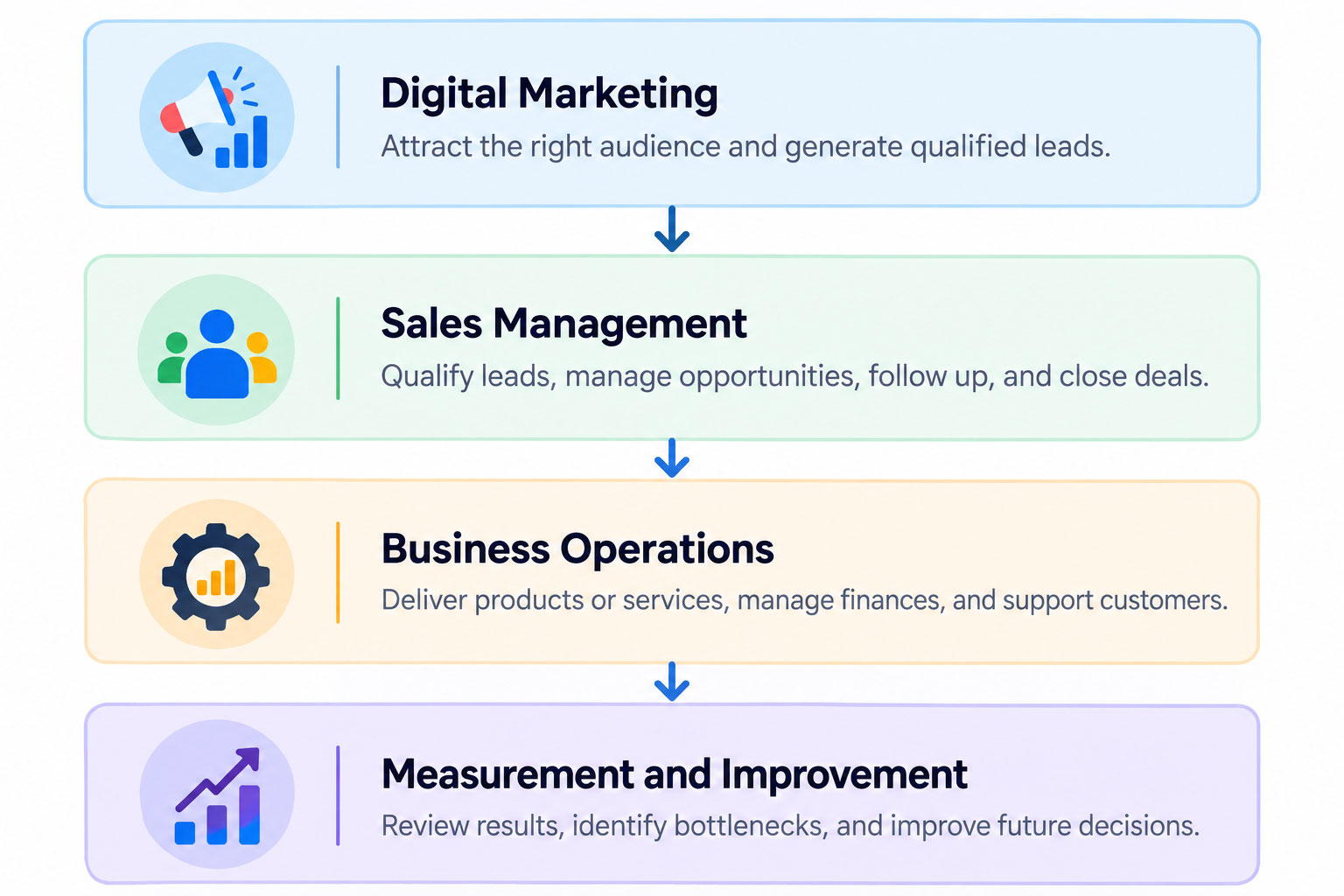
When these functions are connected properly, management can make better decisions using information from the entire customer journey.
For example, the company can compare marketing sources with closed sales, identify which services generate the best margins, and understand where customer acquisition or delivery costs are increasing.
This is more useful than measuring marketing, sales, and operations in isolation.
5. Use Business Analytics to Make Better Decisions
As businesses adopt more digital tools, they collect more information. But having data does not automatically lead to better decisions.
The challenge is identifying which numbers matter.
A marketing team may focus on website traffic and lead generation. Sales may monitor conversion rates and revenue. Finance may track profit margins, cash flow, and overdue invoices. Operations may monitor delivery times, workload, and service quality.
These measures should be reviewed together where possible.
For example, an increase in sales might appear positive until management discovers that discounts have reduced profit margins or that delayed delivery is increasing customer complaints.
Analytics can help reveal these relationships.
Zoho Analytics can combine data from supported sources and help businesses create dashboards and reports. Its usefulness depends on data quality, available integrations, and the indicators the company chooses to monitor.
Start with a manageable set of metrics. A small business usually gains more from reviewing a few reliable indicators consistently than from building a complex dashboard nobody uses.
6. Consider Zoho One for a Connected Business Environment
Businesses that need multiple applications may find it difficult to manage separate subscriptions, user access, and integrations across different systems.
Zoho One offers a broad suite of business applications covering areas such as CRM, finance, email, HR, marketing, analytics, customer support, and collaboration.
A business might use Zoho CRM for sales, Zoho Books for accounting, Zoho Mail for business email, and Zoho People for HR. Additional applications can be considered as requirements grow.
Zoho Creator can address selected needs that require custom business applications.
The advantage is the opportunity to build a more connected business environment using applications from the same ecosystem.
However, Zoho One is not automatically the right choice for every company.
Some businesses may need only one or two applications. Others may have existing systems that are difficult or expensive to replace. Licensing, implementation effort, data migration, integrations, and employee training should all be considered.
The right decision depends on the company's actual needs, not the number of applications included in a package.
7. Common Mistakes That Slow Digital Business Growth
Technology can support growth, but poor implementation can create new problems.
One common mistake is buying software before understanding the business process. A company may purchase a CRM without defining its sales stages or implement accounting software without reviewing its chart of accounts.
Another mistake is allowing employees to continue maintaining separate records outside the new system. This creates conflicting information and makes reporting less reliable.
Some businesses also automate processes that are already inefficient. Automation can make a good process faster, but it can also make a bad process more difficult to correct.
Finally, companies sometimes focus on the initial setup and overlook training, adoption, and ongoing review.
Digital business growth requires more than installing applications. It requires clear processes, reliable information, employee participation, and management commitment.
8. How to Build a Practical Digital Growth Strategy
You do not need to transform the entire business at once.
Start by identifying the most expensive or disruptive problems. These might include lost sales opportunities, delayed invoicing, poor customer records, duplicated data entry, or limited visibility into business performance.
Next, prioritize the changes that can make a measurable difference.
A company struggling to follow up with prospects might begin with Zoho CRM. A business that cannot reliably track income and expenses might start with Zoho Books. A company with several disconnected departments could evaluate Zoho One.
Once the core system is working, review which processes should be integrated or automated.
Before implementation, define what success will look like. This could mean reducing missed follow-ups, shortening the time needed to prepare financial reports, improving collection of overdue invoices, or reducing the manual work required to process an order.
After implementation, compare the results with the original position.
This makes digital transformation a business improvement process rather than a software purchasing exercise.
9. How to Measure Digital Business Growth
The right indicators depend on your business model, but a useful measurement framework should cover marketing, sales, and operations.
|
Business area |
Metrics worth tracking |
|
Marketing |
Qualified leads, cost per lead, conversion by channel |
|
Sales |
Win rate, sales cycle, average deal value, follow-up completion |
|
Finance |
Revenue, gross margin, cash flow, overdue receivables |
|
Operations |
Delivery time, order accuracy, service completion |
|
Customer relationships |
Retention, repeat purchases, customer satisfaction |
Do not attempt to measure everything immediately.
Choose a few indicators that reflect your current priorities. Review them regularly and assign responsibility for acting on the results.
For example, if leads are increasing but sales are not, investigate lead quality, response time, and conversion rates before increasing the advertising budget.
If revenue is growing but cash flow is deteriorating, review payment terms, overdue invoices, operating expenses, and inventory investment.
The value of measurement comes from what the business does with the information.
Final Thoughts
Digital business growth is not just a marketing challenge or a sales target. It depends on the relationship between customer acquisition, revenue generation, financial management, and daily operations.
Marketing brings opportunities into the business. Sales turns those opportunities into customers. Operations deliver the promised value. Financial management helps ensure that growth remains sustainable.
Technology can connect these functions, reduce manual work, and make performance easier to understand.
For businesses looking to build that foundation, Zoho offers several options. Zoho CRM supports customer and sales management, Zoho Books helps organize accounting, Zoho People supports HR processes, and Zoho Analytics helps turn business data into useful reports. Zoho One can be considered when a broader set of connected applications is needed.
But the best starting point is always the same: identify the business problem, improve the process, and then select the technology that supports it.
Sustainable growth comes from attracting the right customers, converting opportunities effectively, and delivering consistently without losing control of the business.
When marketing, sales, and operations work together, technology becomes more than a collection of tools. It becomes part of how the business grows.
Join over 145,000 SEO and Google Ads experts. We provide a community to help you engage and learn from industry experts and influencers. Join Now
World-class digital workplace software for a seamless employee experience, whether you have 10 or 10,000 employees.