Does Zoho Offer Solutions for Freight and Shipping Companies
Originally published: April 28, 2026 09:29:19 AM, updated: April 28, 2026 09:30:19 AM
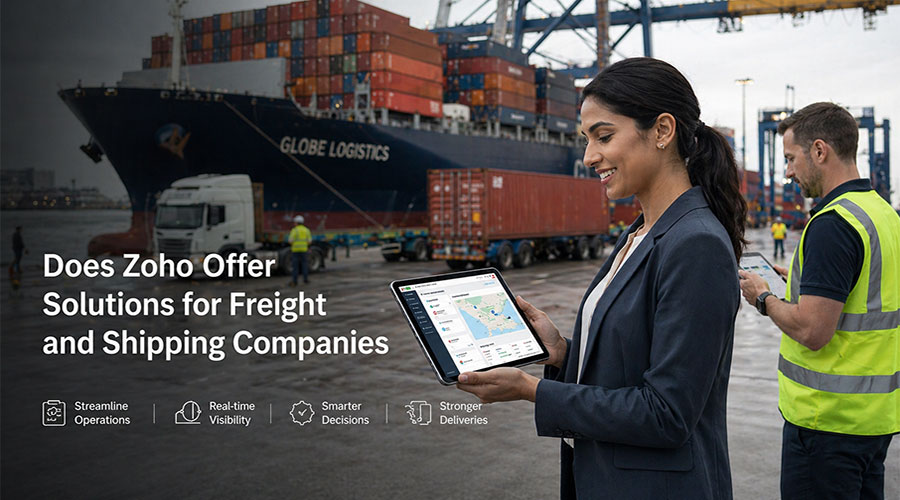
Freight and shipping companies operate in one of the most complex business environments—multiple stakeholders, real-time tracking, documentation, compliance, and tight margins. Naturally, many logistics operators ask:
Can Zoho actually support freight and shipping operations?
The short answer is yes—but not in the traditional “out-of-the-box logistics software” sense. Instead, Zoho offers a flexible, modular ecosystem that can be tailored to meet the needs of freight forwarders, shipping companies, and logistics providers.
Understanding Zoho’s Approach to Logistics
Unlike niche freight software, Zoho does not position itself as a dedicated Transportation Management System (TMS). Instead, it provides a suite of interconnected business applications that, when combined, can fully support logistics workflows.
This approach is often more powerful than rigid logistics platforms—because it adapts to your operations, rather than forcing you into predefined processes.
Key Zoho Applications for Freight & Shipping
1. Customer & Shipment Management
At the core of any logistics business is managing clients, shipments, and communication.
- Zoho CRM
Helps track customers, leads, quotes, and shipment pipelines. - Zoho Creator
Enables building custom apps for shipment tracking, job management, or container movement.
Practical Use Case:
Create a custom shipment module where each job includes origin, destination, carrier, documents, and status updates.
2. Quotation, Billing, and Financial Control
Freight pricing is rarely simple—it involves multiple cost components such as fuel, handling, customs, and warehousing.
- Zoho Books
Manage invoices, expenses, taxes, and financial reports. - Zoho Invoice
Ideal for generating professional invoices quickly.
Practical Use Case:
Automatically convert freight quotes into invoices and track profitability per shipment.
3. Inventory and Warehouse Coordination
For companies dealing with cargo storage or distribution:
- Zoho Inventory
Tracks stock levels, warehouses, and order fulfillment.
This is especially useful for 3PL providers or hybrid logistics businesses.
4. Workflow Automation & Operations
Logistics operations require constant coordination between teams, drivers, and partners.
- Zoho Flow
Connects apps and automates workflows. - Zoho Projects
Helps manage shipment timelines and team tasks.
Practical Use Case:
Trigger automatic notifications when shipment status changes or documents are uploaded.
5. Communication and Collaboration
Freight operations rely heavily on communication.
- Zoho Mail
- Zoho Cliq
These tools centralize communication across teams and clients.
Need Help Implementing Zoho for Your Business?
Choosing the right Zoho applications and configuring them correctly can make a huge difference. Our experts can help you implement Zoho solutions tailored to your business needs.
Get Expert ConsultationWhere Zoho Excels in Logistics
Flexibility Over Rigidity
Zoho allows you to design workflows that match your exact operations—whether you handle air freight, sea freight, or land transportation.
Cost Efficiency
Compared to traditional logistics systems, Zoho is significantly more affordable, especially for small to mid-sized companies.
Integration Across the Business
From sales to invoicing to operations, everything can be connected within one ecosystem.
Where Zoho Falls Short
To be clear, Zoho is not a plug-and-play freight system.
It does not natively include:
- Built-in carrier integrations (like DHL, Maersk APIs out of the box)
- Advanced route optimization engines
- Real-time GPS fleet tracking
These capabilities typically require custom development using Zoho Creator or third-party integrations.
The Smart Way to Use Zoho in Freight
The most effective approach is to treat Zoho as a logistics operating system, not just a tool.
A typical architecture looks like this:
- CRM → Manage customers and deals
- Creator → Handle shipments and operations
- Books → Control finances and profitability
- Flow → Automate processes
- External APIs → Integrate carriers and tracking systems
This setup gives you ERP-like power without ERP complexity.
Real-World Insight
In practice, many freight companies don’t fail because they lack software—they fail because their systems are fragmented.
Zoho solves this by creating a unified environment, where:
- Sales teams know shipment status
- Finance teams see real-time revenue
- Operations teams manage workflows efficiently
That alignment is often more valuable than having a specialized but isolated logistics tool.
Final Verdict
Does Zoho offer solutions for freight and shipping companies?
Yes—but as a customizable ecosystem, not a ready-made logistics platform.
If you are looking for:
- A rigid, prebuilt freight system → Zoho may not be ideal
- A flexible, scalable, and integrated business solution → Zoho is a strong contender
Expert Recommendation
For most freight and shipping companies—especially in emerging markets—the smartest move is:
- Use Zoho as your core business platform
- Extend it with custom logistics workflows
- Integrate external tools where needed
This approach delivers control, scalability, and long-term adaptability—which are critical in the logistics industry.
Join over 145,000 SEO and Google Ads experts. We provide a community to help you engage and learn from industry experts and influencers. Join Now
World-class digital workplace software for a seamless employee experience, whether you have 10 or 10,000 employees.