How to Work Fewer Hours Without Compromising Productivity
Originally published: July 14, 2026 08:50:16 AM, updated: July 15, 2026 07:00:34 AM
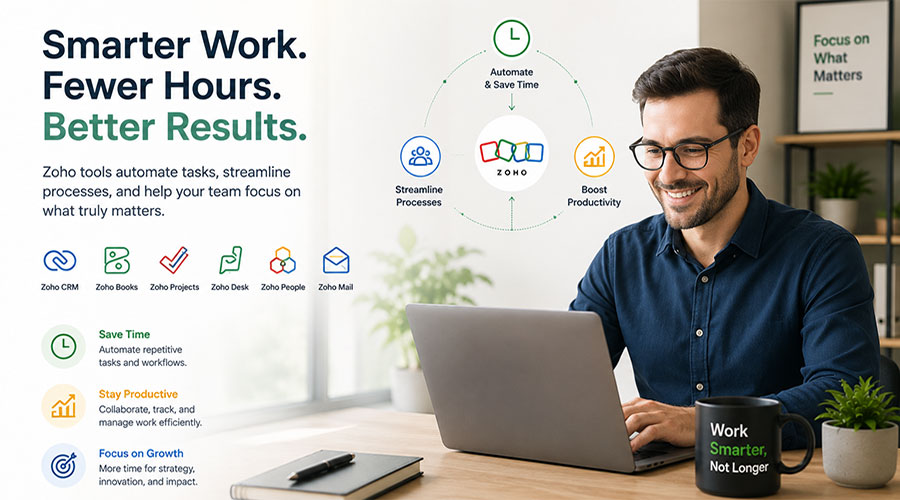
Most business owners don't actually want to work more hours.
They want to accomplish more in the hours they already have.
Yet many professionals spend their days switching between emails, updating spreadsheets, following up with customers, attending unnecessary meetings, and performing repetitive tasks that could easily be automated. At the end of the day, they've been busy, but not necessarily productive.
Working fewer hours isn't about doing less work. It's about removing the work that doesn't require your time.
That's exactly where modern automation and artificial intelligence are changing the way businesses operate. Instead of asking employees to work harder, companies are using smart tools to handle repetitive tasks while people focus on decisions, creativity, and customer relationships.
For businesses already using the Zoho ecosystem, this shift is becoming much easier thanks to powerful automation features and the growing capabilities of Zia, Zoho's AI assistant, including the latest Zia Agents.
Productivity Isn't Measured by Time
Many companies still measure productivity by how long employees stay at their desks.
That's an outdated way of thinking.
Imagine two employees. One works ten hours every day but spends half that time searching for information, writing repetitive emails, and manually updating records. The other works seven hours but uses automation to complete routine work in minutes.
Who is more productive?
The answer is obvious.
Technology should reduce effort, not simply digitize old habits.
Where Most Working Hours Are Lost
Before reducing working hours, it's important to understand where time actually disappears.
For many businesses, the biggest productivity killers include:
- Repetitive data entry
- Manual follow-up emails
- Switching between multiple applications
- Searching for documents
- Scheduling meetings
- Creating routine reports
- Answering the same customer questions repeatedly
Individually, these tasks seem small.
Together, they consume hours every week.
Automation Is No Longer Only for Large Enterprises
There was a time when business automation required expensive software and complex development projects.
That's no longer the case.
Today, businesses of almost any size can automate routine processes using applications from Zoho Corporation.
Instead of replacing employees, automation removes repetitive work so employees can focus on activities that create real value.
The result isn't fewer people.
It's better use of people's time.
Let Your CRM Handle Routine Work
Sales teams often spend surprisingly little time actually selling.
Much of their day is consumed by updating customer records, creating reminders, sending follow-up emails, and tracking opportunities.
Zoho CRM automates many of these activities.
New leads can be assigned automatically.
Follow-up emails can be scheduled without manual effort.
Tasks can be created based on customer actions.
Managers receive updated sales dashboards without asking employees to prepare reports.
Instead of spending hours on administration, sales teams spend more time speaking with customers.
Stop Managing Your Inbox All Day
Email is one of the biggest productivity drains in modern workplaces.
Many professionals check their inbox dozens of times every day, interrupting their focus repeatedly.
Using Zoho Mail together with AI-powered assistance helps organize conversations, prioritize important emails, and reduce time spent managing communication.
When email becomes organized instead of overwhelming, employees recover valuable hours every week.
Let AI Help You Make Decisions
Artificial intelligence isn't only about generating text.
Within the Zoho ecosystem, Zia helps users identify trends, predict outcomes, summarize information, and answer business questions using company data.
Instead of manually reviewing reports or searching for insights, users can simply ask questions and receive meaningful answers.
Managers spend less time gathering information and more time acting on it.
Meet Zia Agents: AI That Works Alongside Your Team
One of the most exciting developments in the Zoho ecosystem is Zia Agents.
Unlike traditional automation, which follows fixed rules, Zia Agents are designed to perform business tasks with greater autonomy.
Think of them as digital teammates rather than simple automation tools.
Depending on how they're configured, Zia Agents can help monitor business activities, assist employees with routine tasks, respond to common requests, summarize information, and support decision-making across different departments.
Instead of asking employees to complete every repetitive task manually, businesses can delegate many of those responsibilities to AI.
That means employees spend less time on routine work and more time solving problems, serving customers, and driving growth.
Reduce Meetings That Don't Need to Happen
Meetings are necessary.
Too many meetings are not.
Many meetings exist simply because information isn't shared effectively elsewhere.
Using Zoho Connect, businesses can share announcements, document decisions, publish updates, and collaborate through dedicated communities.
Employees stay informed without scheduling another meeting.
When meetings become intentional rather than habitual, productivity naturally improves.
Automate Financial Tasks
Finance teams often spend countless hours creating invoices, matching payments, and preparing reports.
Zoho Books automates many accounting processes while keeping financial information organized.
Routine financial work becomes faster, allowing finance teams to focus on analysis instead of administration.
Keep Projects Moving Without Constant Follow-Ups
Managers frequently spend more time chasing updates than managing projects.
With Zoho Projects, task assignments, deadlines, notifications, and progress tracking happen automatically.
Everyone knows what they're responsible for without constant reminder emails.
Projects continue moving even when managers aren't checking every detail.
One Connected Platform Saves More Time Than Multiple Apps
Another hidden productivity challenge is software fragmentation.
Employees jump between email, spreadsheets, messaging apps, project management software, CRM systems, and document storage throughout the day.
- Every switch interrupts concentration.
- Because Zoho applications work together, businesses reduce much of this friction.
- Customer information flows between departments.
- Documents remain connected to projects.
- Sales data appears inside reports automatically.
- Employees spend less time moving information from one system to another.
Need Help Implementing Zoho for Your Business?
Choosing the right Zoho applications and configuring them correctly can make a huge difference. Our experts can help you implement Zoho solutions tailored to your business needs.
Get Expert ConsultationProductivity Is About Energy, Not Just Time
Working fewer hours doesn't mean squeezing eight hours of work into six.
It means removing unnecessary work altogether.
When repetitive tasks disappear, employees have more mental energy for creative thinking, customer conversations, strategic planning, and innovation.
This often improves both productivity and job satisfaction.
People generally perform better when they spend more time doing meaningful work.
Start Small
You don't need to automate your entire business overnight.
- Begin with one repetitive task.
- Automate customer follow-ups.
- Create automatic approval workflows.
- Use AI to summarize reports.
- Reduce manual data entry.
- Once employees experience the benefits, expanding automation becomes much easier.
- Small improvements often produce surprisingly large results.
Case Study: ONE Business Solutions
ONE Business Solutions, a business process outsourcing (BPO) company, wanted to improve communication across a distributed workforce. Source.
After adopting Zoho Workplace, including Zoho Connect, the company created a digital workplace where employees could collaborate, share knowledge, and communicate from one platform instead of relying on disconnected systems.
According to the company, the implementation resulted in:
- Employees feeling more connected while working remotely.
- Better visibility into company information.
- Faster collaboration between departments.
- A 12% increase in business closed, which the company attributes in part to improved internal collaboration and communication.
Frequently Asked Questions
1. Is it really possible to work fewer hours and still get more done?
Yes, but it requires changing how you work rather than simply working faster. Many professionals spend a large part of their day on repetitive tasks like updating records, sending follow-up emails, searching for documents, and preparing reports. By automating these activities and organizing your workflows, you can free up hours every week without reducing your output.
2. What causes people to work long hours without being productive?
Long working hours are often the result of inefficient processes rather than a heavy workload. Constant interruptions, manual data entry, unnecessary meetings, switching between multiple applications, and poor communication can consume more time than people realize. Improving these processes usually has a bigger impact than simply working longer.
3. How can automation reduce working hours?
Automation handles repetitive tasks that don't require human judgment. For example, it can assign leads, send follow-up emails, create reminders, generate reports, or route approvals automatically. Instead of spending time on routine administration, employees can focus on solving problems, serving customers, and making decisions.
4. Which Zoho applications help improve productivity?
Several Zoho applications are designed to save time across different departments. Zoho CRM helps automate sales activities, Zoho Books simplifies accounting processes, Zoho Projects keeps teams organized, Zoho Connect improves internal collaboration, and Zoho Mail makes business communication more manageable. Together, they create a connected digital workplace that reduces manual work.
5. What are Zia Agents, and how do they help businesses?
Zia Agents are AI-powered assistants built into the Zoho ecosystem. Unlike traditional automation, they can assist with more complex tasks such as summarizing meetings, gathering information from different business applications, preparing reports, organizing emails, and helping employees complete routine work more efficiently. They act like digital teammates that support your workforce instead of replacing it.
6. Will using AI replace employees?
In most businesses, the goal isn't to replace people. It's to eliminate repetitive work. AI is best used to handle routine tasks while employees focus on activities that require creativity, critical thinking, customer relationships, and business strategy. The combination of people and AI usually delivers better results than either working alone.
7. Can small businesses benefit from automation and AI?
Absolutely. In fact, small businesses often see the biggest improvements because they have fewer resources and need employees to wear multiple hats. Automating routine work allows small teams to accomplish more without increasing headcount or working longer hours.
8. How much time can businesses realistically save?
The answer depends on the business and its current processes. Many organizations recover several hours per employee every week by automating repetitive tasks and improving collaboration. Over the course of a year, that can translate into hundreds or even thousands of productive hours across the company.
9. Where should a business start if it wants to reduce working hours?
Start with the tasks your team repeats every day. Look for activities like manual follow-ups, approval processes, report generation, or customer data entry. Automating one process at a time is usually more successful than trying to transform the entire business overnight.
10. How does Zoho Connect improve productivity?
Zoho Connect gives employees one central place to communicate, share knowledge, access company information, and collaborate on projects. Instead of searching through email threads or multiple applications, teams can quickly find what they need, stay informed, and work together more efficiently. This reduces unnecessary meetings, repeated questions, and time spent looking for information.
11. Is working fewer hours only possible for large companies?
Not at all. Businesses of every size can improve productivity by simplifying processes and using the right technology. In many cases, smaller companies can move even faster because they have fewer layers of approval and can adopt new tools more quickly.
12. What's the biggest mistake businesses make when trying to improve productivity?
Many companies try to make employees work harder instead of making work easier. Buying new software alone won't solve the problem if inefficient processes remain unchanged. The most successful organizations first identify where time is being wasted, then use automation and AI to remove those bottlenecks.
The Bottom Line
Working fewer hours isn't about doing less.
It's about spending less time on work that technology can handle.
With applications like Zoho CRM, Zoho Books, Zoho Projects, Zoho Connect, and the growing capabilities of Zia and Zia Agents, businesses can automate routine work, improve collaboration, and make better use of every working hour.
The goal isn't to stay busy.
The goal is to create a business where people focus on the work that truly matters while technology quietly takes care of the rest.
Join over 145,000 SEO and Google Ads experts. We provide a community to help you engage and learn from industry experts and influencers. Join Now
World-class digital workplace software for a seamless employee experience, whether you have 10 or 10,000 employees.