Best Business Email Provider: Zoho Mail vs Google Workspace vs Microsoft 365
Originally published: May 07, 2026 08:14:48 AM, updated: June 14, 2026 07:11:14 AM
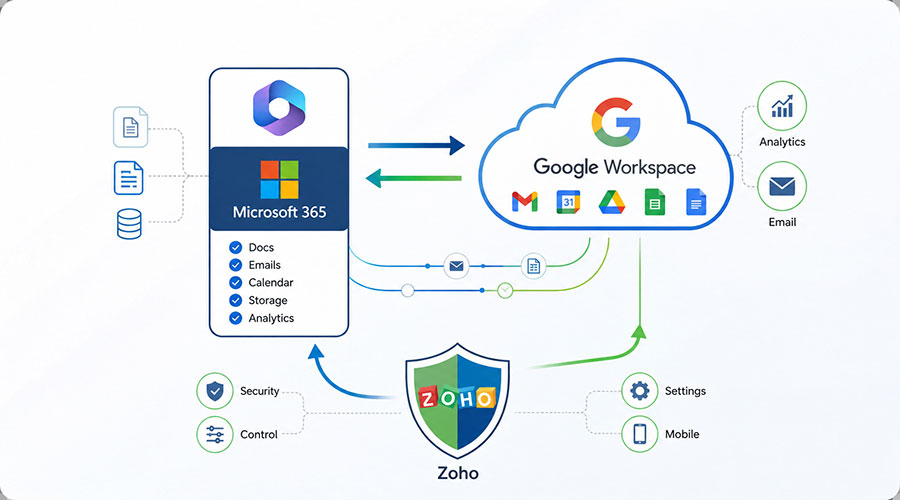
Selecting a business email provider is no longer simply a matter of sending and receiving emails.
Your email platform has become the operational hub for your business. It impacts everything from communication and collaboration, to security, productivity, storage, internal workflows and even how professional your brand appears to your clients.
This is why businesses often compare three major players:
- Zoho Mail
- Google Workspace
- Microsoft 365
Each platform has its strengths, weaknesses and very different philosophies behind them. The best option depends less on popularity and more on how your business works in the real world.
The truth is a lot of companies buy features they never use, or choose systems that bring added complexity.
Let’s break down the real differences.
Why Business Email Matters More Than Ever
A professional email address builds trust immediately.
Customers are much more likely to trust a company with branded email addresses, not free accounts. But beyond branding, modern business email platforms now offer collaboration tools, cloud storage, calendars, meetings, security systems and workflow integrations.
For many companies, the email provider is effectively the digital workplace itself.
Choosing the right platform is therefore a strategic decision, not a technical one.
Zoho Mail: Best for Cost Efficiency and Business Integration
Zoho Mail has quickly gained adoption worldwide by startups, SMEs and companies seeking a clean, affordable, privacy-first alternative.
Zoho Mail is special not only because of the email service but the ecosystem around it.
Whereas Zoho’s strength is in business operations and not so much the productivity suite like its competitors are. Zoho Mail also integrates with the larger Zoho One platform, which includes apps for CRM, accounting, HR, helpdesk and project management.
It creates a connected operational environment, which is something that a lot of businesses find very valuable.
Another key advantage is affordability.
Zoho Mail is typically more affordable than Google Workspace and Microsoft 365, but offers professional email hosting, domain support, calendars, collaboration tools, and strong administrative controls.
This becomes a serious advantage for growing businesses that are trying to control operational costs.
Need Help Implementing Zoho for Your Business?
Choosing the right Zoho applications and configuring them correctly can make a huge difference. Our experts can help you implement Zoho solutions tailored to your business needs.
Get Expert ConsultationWhere Zoho Mail Performs Exceptionally Well
Zoho Mail is perfect for companies seeking simplicity, integration and value.
The interface is clean and not as intimidating as larger enterprise ecosystems. This lighter approach to operations is often preferred by businesses that don’t need highly advanced enterprise infrastructure.
Zoho is also getting attention in the privacy space.
Unlike the companies that have been deeply embedded into the advertising ecosystem, Zoho has positioned itself as a privacy-first provider. This is a good place to be for companies who worry about data management and long-term independence.
In addition, companies already using Zoho applications find their operations flow more smoothly with email communications tightly integrated with sales, finance, support and operations.
Google Workspace: Best for Collaboration and Simplicity
Google Workspace continues to be one of the most popular business email solutions around the globe—and for good reason.
The biggest strength of the organization is its collaborative nature.
Apps like Gmail, Google Drive, Google Docs, Google Meet, and Google Calendar work together very smoothly. Real-time editing and cloud collaboration still remain one of Google’s strongest competitive advantage.
Google Workspace is a popular choice among many companies because employees are already familiar with Gmail. That reduces training requirements and speeds up adoption.
The platform also excels for remote teams and businesses that rely heavily on real-time collaboration.
But there are costs.
Google Workspace is more about communication and collaboration, where it shines, but less about business processes than the Zoho ecosystem. Many companies find themselves having to rely on other third-party tools for CRM, accounting, HR and operations.
This can cause broken workflows and increased software costs over time.
Microsoft 365: Best for Enterprise Environments
Microsoft 365 is the big player in large enterprise environments, particularly for organizations heavily married to the Microsoft ecosystem.
Its strength is enterprise productivity and infrastructure.
Apps such as Outlook, Excel, Word, Teams and SharePoint remain deeply embedded in corporate environments across the world. Companies with sophisticated document management needs or that depend heavily on Excel tend to organically gravitate toward Microsoft 365.
Microsoft also has great enterprise security, compliance and admin tools.
But this power is often accompanied by complexity.
Microsoft 365 can be overwhelming for smaller companies. It has many capabilities that many organizations use just a fraction of but pay enterprise level pricing.
The user experience can also feel a little bit heavier than Google Workspace or Zoho Mail, especially for non-technical teams.
Which Platform Is Best for Small Businesses?
For many small and medium-sized businesses, Zoho Mail is often the best mix of cost, functionality and operational integration.
Google Workspace is great for teams that collaborate a lot, but Microsoft 365 is better for big companies.
But for businesses looking for a broader operational ecosystem, not just email, Zoho’s approach often makes more strategic long-term sense.
This is especially true for companies looking to grow operations incrementally without the constant acquisition of fragmented software subscriptions.
The Hidden Cost Most Businesses Ignore
Many companies compare only email pricing.
This is a mistake.
The real cost of a business email platform includes:
- Additional software subscriptions
- Workflow inefficiencies
- Integration limitations
- Administrative complexity
- Employee productivity
- Long-term scalability
A cheaper monthly email plan can become more expensive operationally if it forces businesses to rely on multiple external systems.
This is one reason many companies eventually migrate toward more integrated ecosystems.
Security and Reliability
All three providers have strong security standards, reliable uptime, spam protection and administrative controls.
But their philosophies are a bit different.
Microsoft is very focused on enterprise-grade security infrastructure. Google puts the focus on cloud native collaboration and automation. Zoho focuses on privacy, ownership of your business, and working into your operations.
All three platforms are more than reliable enough to run professionally for most businesses.
It usually comes down to workflow preference and ecosystem strategy, not basic email functionality.
Need Help Implementing Zoho for Your Business?
Choosing the right Zoho applications and configuring them correctly can make a huge difference. Our experts can help you implement Zoho solutions tailored to your business needs.
Get Expert ConsultationWhich Business Email Provider Should You Choose?
There is no universal winner.
The right choice depends on your business size, operational style, growth strategy, and software ecosystem.
Choose Zoho Mail if you want:
- Strong value for money
- Integrated business operations
- A clean and lightweight ecosystem
- Better alignment with CRM and operational workflows
Choose Google Workspace if collaboration is your highest priority.
Choose Microsoft 365 if your organization depends heavily on enterprise infrastructure and advanced Microsoft applications.
Final Thoughts
The Zoho Mail vs Google Workspace vs Microsoft 365 debate is no longer just about email.
It's about how your business works.
Email platforms impact productivity, collaboration, scalability, automation and operational efficiency across the enterprise.
For businesses that need affordability, integration with other services and long-term operational flexibility, Zoho Mail is becoming an ever more compelling offering.
The smartest decision is not to choose the most popular platform.
It’s about picking the platform that best supports how your business actually works – and how you plan to grow in the future.
Join over 145,000 SEO and Google Ads experts. We provide a community to help you engage and learn from industry experts and influencers. Join Now
World-class digital workplace software for a seamless employee experience, whether you have 10 or 10,000 employees.