TrainerCentral vs. Zoho Classes
Originally published: August 12, 2026 09:47:44 AM, updated: August 12, 2026 10:08:46 AM
When organizations start looking for an online learning platform, it is easy to assume that all LMS products are essentially the same.
They are not.
This becomes particularly interesting when comparing Zoho TrainerCentral with Zoho Classes. Both are Zoho products. Both can be used to create and deliver courses. Both support learners, assessments and online learning. Both can help organizations move away from traditional classroom-only education.
So, naturally, the question comes up:
What is the actual difference between TrainerCentral and Zoho Classes?
The answer is more important than a simple feature comparison.
Although the two products overlap in some areas, they were designed around different types of organizations and different approaches to learning.
In simple terms, TrainerCentral is built around the training business, while Zoho Classes is built around the academic institution.
That distinction is what I would look at first when recommending one of them to a client.
The easiest way to understand the difference
Think about two organizations.
The first is a professional training company. It sells courses to individuals and businesses. It wants to advertise its courses, accept payments, run live workshops, offer subscriptions, issue certificates and track learners.
The second is a university. It has students, teachers, departments, subjects, attendance, assignments, exams, academic schedules and learning outcomes.
Both organizations need an LMS.
But they don't need the same kind of LMS.
The training company is essentially asking:
How can we build and run a successful training business online?
The university is asking:
How can we manage teaching, learning, students and academic processes?
That is where TrainerCentral and Zoho Classes begin to separate.
Need Help Implementing Zoho for Your Business?
Choosing the right Zoho applications and configuring them correctly can make a huge difference. Our experts can help you implement Zoho solutions tailored to your business needs.
Get Expert ConsultationWhat is TrainerCentral?
TrainerCentral is Zoho's platform for creating and delivering online training programs.
It is particularly interesting for trainers, consultants, coaches, professional academies and businesses that want to turn their knowledge into structured online training.
The platform combines course creation, learner management, live training and commercial tools in one environment. Zoho describes TrainerCentral as a platform for creating courses, marketing content, engaging learners and managing a training business.
You can create self-paced courses, run live virtual sessions, provide assignments and tests, issue completion certificates and monitor learner activity.
But what really separates TrainerCentral from a traditional academic LMS is the commercial side.
TrainerCentral allows training providers to sell their courses using different pricing models, including one-time payments, subscriptions, custom payment plans and partial payments. It also supports multiple currencies and country-specific pricing.
That makes a big difference.
Imagine a company offering a course called:
Digital Marketing Masterclass
It might want to sell the course for $299, offer a monthly subscription, provide a three-payment option, run a promotional coupon and allow customers from different countries to pay in their local currency.
That is the type of scenario TrainerCentral is designed to handle.
What is Zoho Classes?
Zoho Classes approaches the problem from a different direction.
Zoho currently positions Classes as an AI-powered student engagement platform for educators and students, with capabilities aimed at schools, colleges, universities and large educational organizations.
The emphasis is much more academic.
A typical Classes environment may involve:
- Students
- Teachers and faculty
- Courses and subjects
- Syllabus
- Assignments
- Practice tests
- Exams
- Attendance
- Academic updates
- Learning content
- Student engagement
- Academic outcomes
Zoho Classes also supports institutions with multiple branches, allowing them to distribute courses, announcements and question papers across their educational network.
That is a very different problem from selling an online course.
A university does not necessarily need a sophisticated sales funnel for every subject it teaches. It needs a system that helps teachers teach and students learn while giving the institution better control over the academic process.
That is where Classes makes more sense.
Why the two products are often confused
The confusion is understandable.
Both platforms can have:
- Courses
- Learners
- Teachers
- Assignments
- Tests
- Certificates
- Online learning
- Mobile access
- Progress tracking
If you compare only those features, the products can look remarkably similar.
But features don't tell the whole story.
For example, both platforms can support assessments, but the context is different.
In TrainerCentral, an assessment might be part of a professional certification course.
In Zoho Classes, an assessment can be part of a much larger academic structure involving subjects, syllabus, course outcomes, program objectives and formal examinations.
That difference is much more important than the fact that both products have a button called "Create Test."
TrainerCentral is built for the training business
This is probably the clearest way to position TrainerCentral.
The platform doesn't stop when the course is created.
It helps the trainer take the course to market.
TrainerCentral provides tools for building a training website, creating sales pages, managing payments and subscriptions, applying branding, offering coupons and discounts, and creating different pricing options.
This means the platform can cover much of the journey from attracting a learner to delivering the training.
A simplified journey might look like this:
Marketing → Sales Page → Payment → Enrollment → Training → Assessment → Certificate
That is a very attractive model for a commercial training company.
It also explains why TrainerCentral is a strong option for coaches and consultants.
Someone who has expertise in leadership, sales, digital marketing, project management or another professional field can package that expertise into courses and sell access to it.
Need Help Implementing Zoho for Your Business?
Choosing the right Zoho applications and configuring them correctly can make a huge difference. Our experts can help you implement Zoho solutions tailored to your business needs.
Get Expert ConsultationTrainerCentral's live training capabilities
Another area where TrainerCentral is particularly strong is live online training.
Its virtual classroom supports capabilities such as screen sharing, video, chat, polls, quizzes, whiteboards and breakout rooms. TrainerCentral also supports recording and other live-session functions.
That makes it suitable for organizations that combine recorded content with live interaction.
For example:
Week 1: Recorded lessons
Week 2: Live workshop
Week 3: Assignment
Week 4: Live Q&A
Week 5: Final assessment
That kind of blended training model fits naturally into TrainerCentral.
It is particularly useful for professional academies, coaching businesses and corporate training providers.
Where Zoho Classes starts to pull ahead
Now consider a university.
The university may need to know:
- Which students belong to which class?
- Which teacher is responsible for a subject?
- What is the syllabus?
- Who attended today's class?
- Which assignments are overdue?
- When is the examination?
- How are students performing?
- Which learning outcomes have been achieved?
- How do we distribute the same content across multiple branches?
These aren't primarily sales questions.
They are academic administration and student engagement questions.
This is where Zoho Classes is much better aligned with the organization's needs.
The current product includes dedicated attendance capabilities, examination management, assignments, practice tests and academic content distribution.
Attendance is a good example of the difference
Attendance may sound like a simple feature.
But in an academic environment, it can be an important part of the institution's daily operation.
Zoho Classes provides an attendance dashboard, class and period attendance tracking, reports and absence notifications.
That makes sense for a school or university.
A commercial training company may occasionally want to know whether someone attended a live workshop, but attendance is usually not the central administrative structure of the business.
This is a good example of why simply counting features can be misleading.
Examinations are another important difference
Zoho Classes has developed a much more academic assessment environment.
Its current examination capabilities include MCQ exams, multimedia submissions, live submission tracking, analytics, mobile grading and PDF annotation exams.
This is much closer to what an academic institution expects from an LMS.
TrainerCentral also supports tests, quizzes and assignments, so it is certainly capable of assessing learners.
The difference is the context.
TrainerCentral's assessment model fits naturally into professional training.
Zoho Classes goes further into the academic examination process.
The academic outcome side is a major differentiator
There is one Zoho Classes capability that makes the academic distinction particularly obvious: CO-PO mapping.
For institutions using outcome-based education, Zoho Classes allows programs and program objectives to be defined, course outcomes to be mapped from the syllabus, assessments to be connected to those outcomes and student attainment to be tracked.
This is not something most commercial training companies need.
A university or engineering college may, however, have very specific requirements around course outcomes, program outcomes and accreditation.
This is a strong example of where Zoho Classes is solving a problem that TrainerCentral was not primarily designed to solve.
Zoho Classes is also moving strongly into AI
The current generation of Zoho Classes is not simply an older LMS with a few AI features added.
Zoho has placed considerable emphasis on AI-powered learning.
One of the most interesting examples is the AI Tutor, which gives each student an AI assistant that can help answer questions and support learning.
Classes also supports AI-assisted course creation and micro-learning experiences.
For an educational institution, this opens up interesting possibilities around personalized learning and student engagement.
It also shows where Zoho appears to be taking the product: not simply toward online course delivery, but toward a broader digital learning environment.
TrainerCentral is also adding AI
It is important not to suggest that AI is exclusive to Zoho Classes.
TrainerCentral has also introduced AI capabilities.
The current Professional plan includes an AI-powered course builder, AI-generated curriculum, AI-generated lesson material and AI-generated assessments.
The difference is not that one product has AI and the other does not.
The difference is how the AI capabilities fit into the overall product.
TrainerCentral's AI capabilities are closely connected to creating and delivering training.
Zoho Classes' AI capabilities are more closely connected to teaching, student engagement and academic learning.
What about selling courses?
This is where I would normally recommend TrainerCentral without much hesitation.
If your business model is:
"People discover our courses, pay us, enroll and learn online."
TrainerCentral is a natural fit.
Its commercial capabilities include different ticket types, subscriptions, payment plans, partial payments, multiple currencies, coupons and discounts.
TrainerCentral also provides tools for building a branded training website and sales pages.
That means your learning platform can also play a role in your sales process.
For a training company, that is a major advantage.
What if the organization is a training institute?
This is where the decision becomes more interesting.
The term "training institute" by itself doesn't tell us which product to choose.
Suppose an institute teaches professional courses and charges students for every program.
It might look like:
Student registers → pays → attends course → completes assignments → takes final test → receives certificate
That sounds much more like TrainerCentral.
But another institute might operate more like a college:
Student admission → program → semester → subjects → faculty → syllabus → attendance → examinations → academic results
That sounds much more like Zoho Classes.
So when I speak to a client, I would not ask:
"Are you a training institute?"
I would ask:
"How does your organization actually operate?"
That usually reveals the answer.
A practical comparison
|
Requirement |
Better fit |
|
Sell online courses |
TrainerCentral |
|
Course subscriptions |
TrainerCentral |
|
Payment plans |
TrainerCentral |
|
Coupons and discounts |
TrainerCentral |
|
Commercial training website |
TrainerCentral |
|
Professional coaching |
TrainerCentral |
|
Online workshops |
TrainerCentral |
|
Corporate training |
TrainerCentral |
|
Customer education |
TrainerCentral |
|
Self-paced professional courses |
TrainerCentral |
|
Academic student management |
Zoho Classes |
|
School environment |
Zoho Classes |
|
University environment |
Zoho Classes |
|
Attendance |
Zoho Classes |
|
Academic syllabus |
Zoho Classes |
|
Academic examinations |
Zoho Classes |
|
Academic assignments |
Zoho Classes |
|
Academic announcements |
Zoho Classes |
|
Multi-branch educational distribution |
Zoho Classes |
|
CO-PO mapping |
Zoho Classes |
|
Academic outcome tracking |
Zoho Classes |
|
AI Tutor |
Zoho Classes |
|
Academic micro-learning |
Zoho Classes |
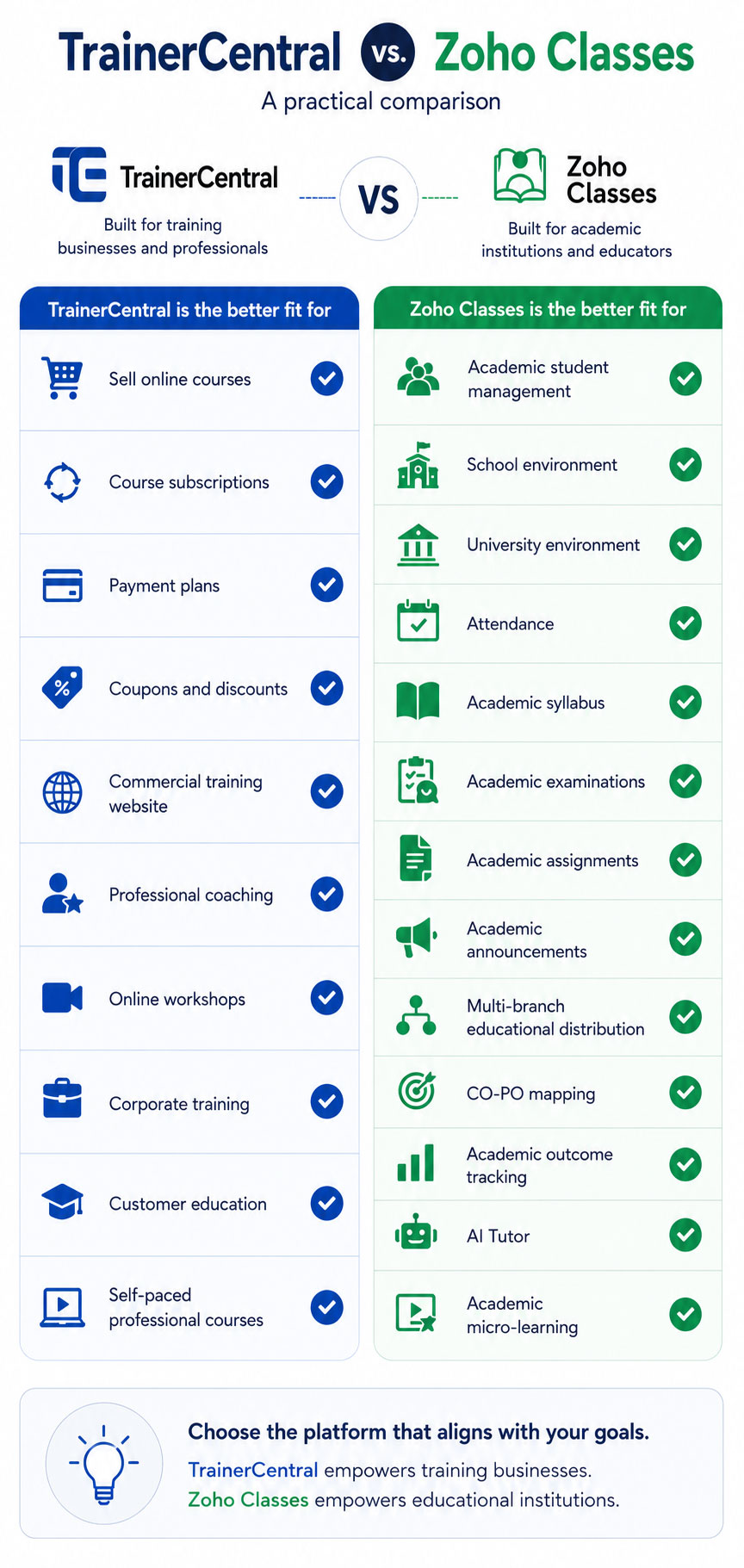
This isn't intended to suggest that the other product cannot perform any of these functions. The point is which product is better aligned with the organization's primary operating model.
What if you need both?
There are organizations that sit somewhere between the two models.
For example, a university might have its regular academic programs but also run a separate professional education center that sells external courses.
In that situation, there may be a legitimate reason to consider both platforms.
The university's academic programs could operate in Zoho Classes, while the professional training operation could use TrainerCentral.
But I would not recommend using two platforms simply because both have attractive features.
Running two learning platforms creates additional work around:
- User management
- Data
- Integrations
- Reporting
- Branding
- Administration
- Authentication
- Support
There should be a clear operational reason before introducing both.
TrainerCentral vs. Zoho Classes: Which one is better?
This is probably the wrong question.
There isn't a universal winner.
A better question is:
Which one is better for your organization?
If you are a consultant selling coaching programs, I would not choose Zoho Classes simply because it has strong academic functionality.
If you are a university, I would not choose TrainerCentral simply because it has excellent course-selling tools.
The product should follow the operating model.
My recommendation in simple terms
If your organization is primarily focused on selling and delivering training, start with TrainerCentral.
It is particularly suitable for:
- Training companies
- Coaches
- Consultants
- Professional academies
- Certification providers
- Corporate training providers
- Online educators
- Workshop providers
- Customer training programs
TrainerCentral is designed around creating courses, engaging learners and running a training business, with commercial capabilities built into the platform.
If your organization is primarily focused on academic education, start with Zoho Classes.
It is particularly suitable for:
- Schools
- Colleges
- Universities
- Government education organizations
- Academic institutions
- Multi-branch educational organizations
Zoho Classes is designed around students, educators, academic learning, assessments, attendance, content distribution and student engagement.
Need Help Implementing Zoho for Your Business?
Choosing the right Zoho applications and configuring them correctly can make a huge difference. Our experts can help you implement Zoho solutions tailored to your business needs.
Get Expert ConsultationThe simplest way to remember it
After looking at both platforms, I think the difference can be explained very simply.
TrainerCentral is about running training.
Zoho Classes is about running academic learning.
TrainerCentral starts with the trainer and the training business.
Zoho Classes starts with the institution, teacher and student.
There is overlap, and there will naturally be more overlap as both products continue to evolve. But the underlying positioning remains the most useful way to make the decision.
Final Thoughts
I don't think organizations should choose between TrainerCentral and Zoho Classes by opening a feature comparison sheet and counting how many checkmarks each product has.
That approach can easily lead to the wrong conclusion.
Instead, start with the organization's actual workflow.
If the workflow looks like:
Market → Sell → Enroll → Train → Assess → Certify
TrainerCentral is probably the better place to start.
If the workflow looks like:
Enroll → Teach → Attend → Assign → Examine → Evaluate → Improve
Zoho Classes is probably the better fit.
And if the organization operates somewhere in between, that is where a proper requirements assessment becomes important.
The good news is that both products are part of the Zoho ecosystem, so organizations are not choosing between completely unrelated technologies. The real decision is about choosing the platform whose design philosophy matches the way the organization teaches and operates.
For businesses looking to build a commercial online training operation, TrainerCentral deserves serious consideration.
For schools, colleges, universities and other organizations managing a structured academic environment, Zoho Classes is the more natural choice.
The important thing is not to ask which platform has more features.
Ask which platform was built to solve your particular problem.
A note for businesses evaluating either platform
Product capabilities, subscription limits, pricing, integrations and AI functionality can change as SaaS platforms evolve. Before entering into an implementation agreement, organizations should verify the applicable Zoho edition, current product documentation and the specific features required for the project.
An implementation agreement should also clearly distinguish between:
- Features provided by Zoho
- Configuration performed by the implementation partner
- Custom development
- Third-party integrations
- Data migration
- Training and support
- Features that depend on the customer's Zoho subscription
- Future changes to the Zoho platform
This is especially important when the learning platform is being used as a core system for a school, university or commercial training business.
The platform should be selected based on the organization's requirements first, and the subscription plan should be selected afterward.
Join over 145,000 SEO and Google Ads experts. We provide a community to help you engage and learn from industry experts and influencers. Join Now
World-class digital workplace software for a seamless employee experience, whether you have 10 or 10,000 employees.